Home
Welcome to the world of martial arts where dwells the brave at heart and firm in spirit, where fears are vanquished at the blink of an eye, and where the mind stays calm under the onslaught of tyranny.
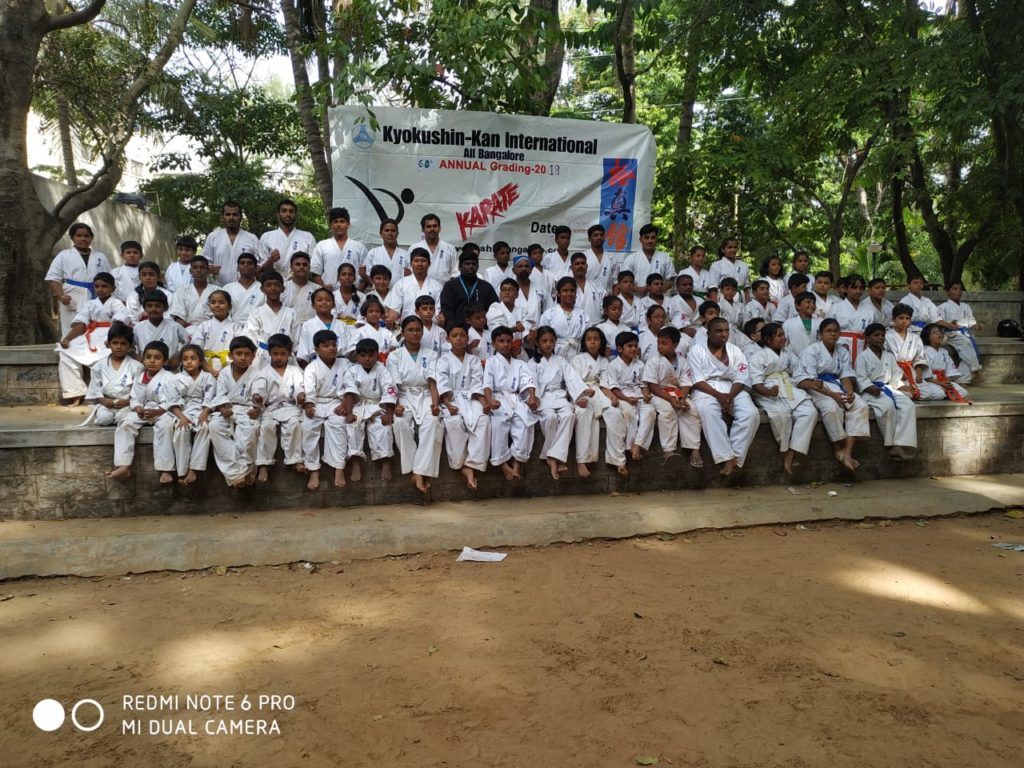
We at Kyokushin, Bangalore (affiliated to International Budo Karate Organisation – Honbu, Japan) will train you to see your worst fears straight in the eyes and fight them. We train you to push yourself beyond the boundaries you see yourself trapped within. We teach you to fight your battles at all levels, be it physical or mental. Through karate you can train yourself towards lifelong physical and mental fitness. Karate can be started with any level of physical and mental fitness. Once started the sky is the limit for a karateka. Anyone who wants physical fitness, mental toughness, a pleasing personality and knowledge of excellent self-defense techniques will find themselves at the right place at Kyokushin. We welcome you once again.
Beginners are always welcome here…
Any person starting out on martial arts is welcome to come and try out training in Kyokushin Karate with us. The only thing we ask is that you make a commitment to train (at least) thrice a week at the club and practice as much as possible at home. Kyokushin is not for everyone and certainly isn’t for the faint-hearted, but even a timid or weak person can excel beyond an average human if they apply themselves fully. Willingness to persevere, to continuously learn and commitment to practice are far more important than any natural ability or physical prowess. Discipline and etiquette prevail within the dojo (training hall). Karate begins and ends with courtesy.
Achieving a black belt is not the ultimate goal…
If your first question to a potential martial arts instructor is ‘how long will it take me to get a black belt?’ then our best advice to you would be to go out and buy yourself one. The modern grading system is a very recent innovation within the martial arts. The coloured belts and ‘kyu’ grades used by karate foundations world over help to structure and track progress of learning and give the students something to strive for. In the early days of Kyokushin in Japan there were no coloured belts, just white and black, and there was no expected grading time for a student, people graded when they were told to, and often waited up to six months for their result. Anyone that has achieved a black belt in a genuine Kyokushin organisation will tell you that it means a great deal to them, because the road is hard and long. However, and ironically speaking, black belt really is only the beginning, hence the term ‘Shodan’ as opposed to ‘Ichidan’, which is the term for a 1st Dan black belt, and Shodan roughly translates to ‘beginner’s grade’. Ultimately, it is the person wearing the belt that counts, not the belt itself.
In order to learn how to fight, you need to fight..
Much is said these days about safety in training. Our politically correct, health and safety obsessed society seems to suggest that we can achieve great things with virtually no risk, and it is common for martial arts clubs to pitch safety as a selling point. Obviously, no sensible instructor wants their students to be injured and from an insurance point of view it is critical that the club is run with a responsibility for everyone’s safety in mind. However, if a person has managed to progress to a high level without ever having been hurt or afraid then they will be woefully unprepared for the reality of real confrontation. Training towards sport based semi-contact competition is fine, purely as a sport, as the training is purely with a view in improving fitness or losing weight, but if you’re serious about wanting to defend yourself then you have to get real. All systems have flaws, but there is no greater shortcoming than students being totally protected from contact and pain throughout their training whilst being told that they are learning a practical method of self-defense. Your instructor will not be there to monitor the contact if you are unfortunate enough to be attacked.